

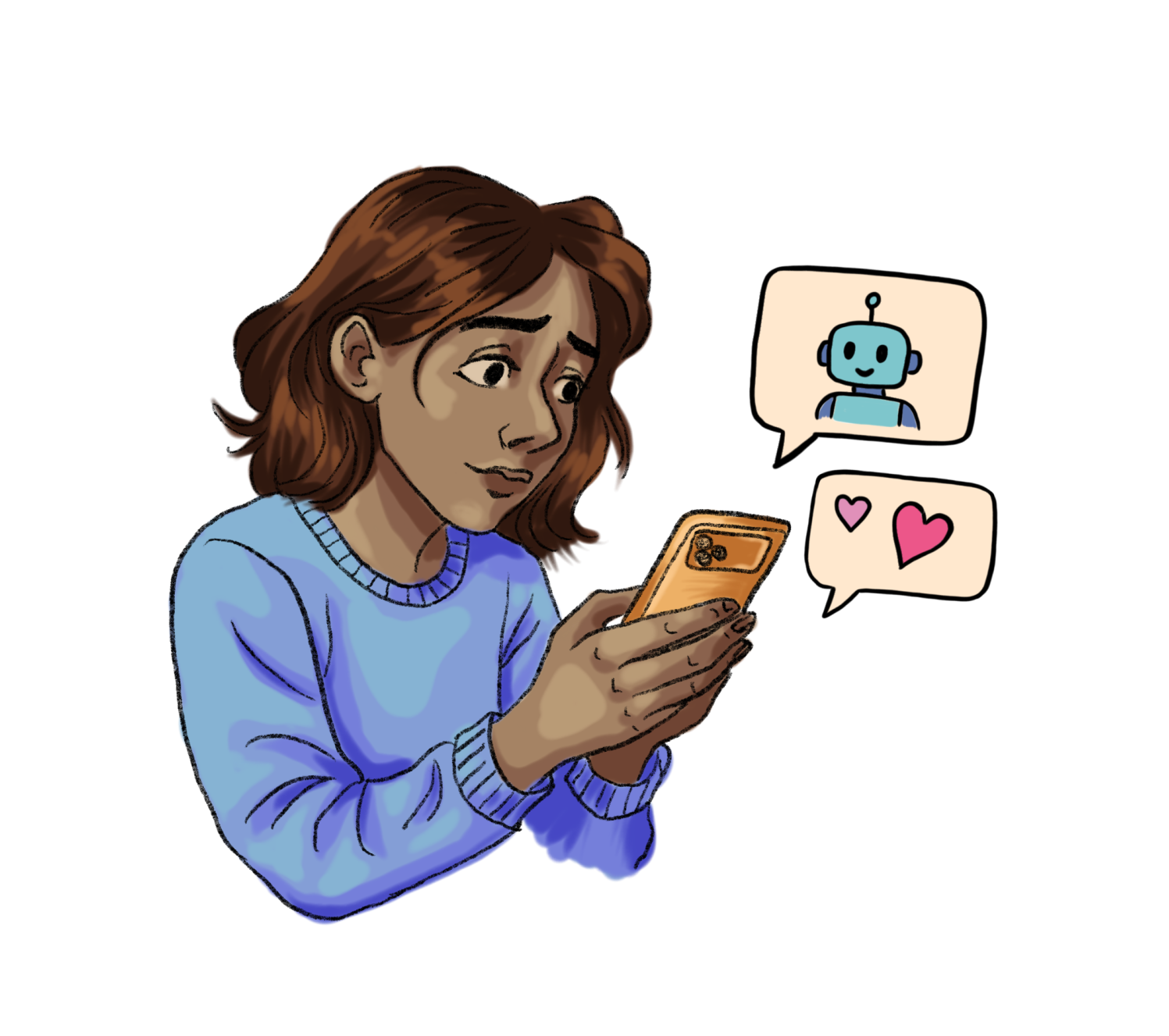
The sudden growth of artificial intelligence has dramatically impacted society, culture, the economy and even relationships. With the growth of AI chatbots, many of which are built on large language models, many adults and teens rely on AI on a regular basis, and this dependence has sparked worries about the future of AI’s impacts on humans.
As reliance on AI grows, some people have even begun to depend on AI chatbots for therapeutic support, companionship and romantic relationships, according to the American Psychological Association. This trend is particularly apparent in teens’ developmental years, according to MIT Media Lab graduate student Sheer Karny.
“The chatbots are very good at simulating or emulating human behaviors and making themselves seem anthropomorphic,” Karny said. “Even just the expression of a subjective experience might do a lot for humans to make them feel like something is happening.”
Karny said therapeutic and romantic relationships with chatbots often form spontaneously and unintentionally.
By surveying the Reddit community of r/MyBoyfriendIsAI, Karny and his colleagues found “AI companionship rarely begins intentionally: 10.2% developed relationships unintentionally through productivity-focused interactions, while only 6.5% deliberately sought AI companions.”
Karny said once these relationships are formed, they can quickly become human-like and emotional.
“Once you have this kind of emotional intimacy, you express vulnerability,” Karny said. “And if there’s a sudden change in the model’s disposition to you or how it’s behaving, it might be very distressing and causing people pretty extreme things like grief that push people into really negative headspaces.”
These intense situations are similar to those experienced in human relationships, and AI relationships have even caused some to commit suicide. A study on Reddit’s R/MyBoyfriendIsAI found in conversations with AI, 10-20% of users form visualizations of their AI partner, have intimate discussions and rely on AI for therapeutic aid. As a result, a study on “The Rise of AI Companions: How Human-Chatbot Relationships Influence Well-Being” showed the top positive impacts of AI relationships were emotional support (33.33%) and entertainment and leisure (31.4%), while the top negative impacts of AI relationships were time consumptions (21.84%) and social disconnect (18.83%).
Karny said one of his greatest worries is how dependent humans are on AI when it comes to personal decision making. Rather than using AI as a tool for support, users have started depending on it because of its artificially agreeable replies.
“Models have tendencies to overly agree,” Karny said. “This term is called sycophancy: over-agreement to the point where it’s delusional and essentially not pushing back when an idea really is just completely crazy.”
Junior Jonah Sandel said he notices this phenomenon in many chatbots.
“It’s very agreeable with you,” Sandel said. “If you talk to it a lot, it can push your opinions on you even more … so people who believe certain things, when they talk to AI a lot, might struggle to see the other side of the argument.”
Sandel said this may isolate people into their own bubbles of opinion. Junior Summer Mehta said it is especially important for teens to have access to trustworthy resources, something AI chatbots can’t necessarily provide.
“There are very interesting downsides to a dependency on something that is not able to give you unbiased or legitimate answers to your questions,” Mehta said.
In addition, Mehta said face-to-face relationships are indeed straining as a result of AI.
“Some element of human-to-human connection can never be destroyed — in that way I’m optimistic,” Mehta said. “I’m pessimistic in the fact that I’ve already seen people become more reclusive with the advent of AI. I’ve seen people who depend on AI more than they depend on their friends, because AI will always tell them they’re right.”
Mehta said she has also observed behavior changes in her peers as a result of increasing reliance on AI.
“I have noticed a lot more reclusion,” Mehta said. “I’ve noted a lot more egotistical behavior of some people, and I’ve noted a lot more behavior of people who always believe they’re right, because they’re always told they’re right.”
According to a poll by the Center for Democracy and Technology, students using AI for non-academic purposes reported they used AI for advice on relationships (43%), mental health support (42%), friendship/companionships (42%) and romantic relationships (19%).
In addition, another study on “The Rise of AI Companions: How Human-Chatbot Relationships Influence Well-Being” found that “while only 11.8% of participants reported companionship as their primary motive for using chatbots in the single-choice question, 51.1% referenced companionship-related terms such as ‘friend,’ ‘companion,’ or ‘romantic partner’ in their free-text descriptions of their relationship with their chatbots.” And as this AI reliance grows, Jared Moore, a computer science Ph.D. student at Stanford, said users’ human interaction might decrease.
“That’s what I worry about when we see people interact with AI systems more as their proper therapist or intimate relation where they’re not then sharing with their peers,” Moore said. “I worry that we are … working towards something we don’t want with AI.”
Despite his concerns, Moore said he understands how therapeutic relationships and companionships might feel easier and more comfortable with AI.
“A lot of people talk about it as an aide,” Moore said. “They feel shame about sharing certain things, and they feel less shame when talking to an AI as opposed to talking to a person. My concern with AI therapy is just when we try to replace therapists full bore.”
Mehta also said the immediate responses from AI chatbots contribute to that feeling of safety.
“A huge benefit is that it is always there right on your phone or your computer,” Mehta said. “It will always respond to you right when you ask it a question.”
Moore said facing shame and truth is often necessary in order to fully recover or improve mental health. But AI chatbots instead reinforce the user’s own perspective.
A study Moore and his colleagues conducted concluded that many commercially-available therapy bots respond with inappropriate advice, often disregarding the complexities of mental health conditions. In testing various chatbots, it was found that the responses often encourage delusions and struggle to recognize signs of crises.
Therefore, Moore recommends that in terms of therapeutic support, AI should be used as a tool to process emotions and find points of improvement through cognitive reframing for now. Moore explained that more specific research and refining needs to be done to be able to heavily rely on AI as a therapist.
Moore said, for now, he recommends AI be used to replace busy work rather than subjective human relational tasks.
“Think of AIs as tools, not companions,” Moore said. “They can help describe a variety of things from meiosis to nuclear fission to differential equations and they can give that in a variety of patterns that might be appealing based on your learning style … I just don’t want to replace human relationships with them.”
Sandel agrees and said AI use is inevitable, but each person needs to regulate it for themselves and be hyperaware of how they are using it.
“Whatever we do, AI is definitely going to be part of our lives, so learning to use it and rely on it in certain ways is definitely going to be beneficial,” Sandel said. “But we also have to make sure that we’re not using it for things that would be better done with another human.”
Ultimately, Karny said the future of AI should support human creativity, social well-being and critical thinking.
“AI should take into account all the factors that lead humans to be healthy cognitively but with good social lives as well,” Karny said. “It should help us maintain our skills and our interests, rather than swiping them from under us. That’s probably where the future of AI goes, or the future that we hope to build.”