

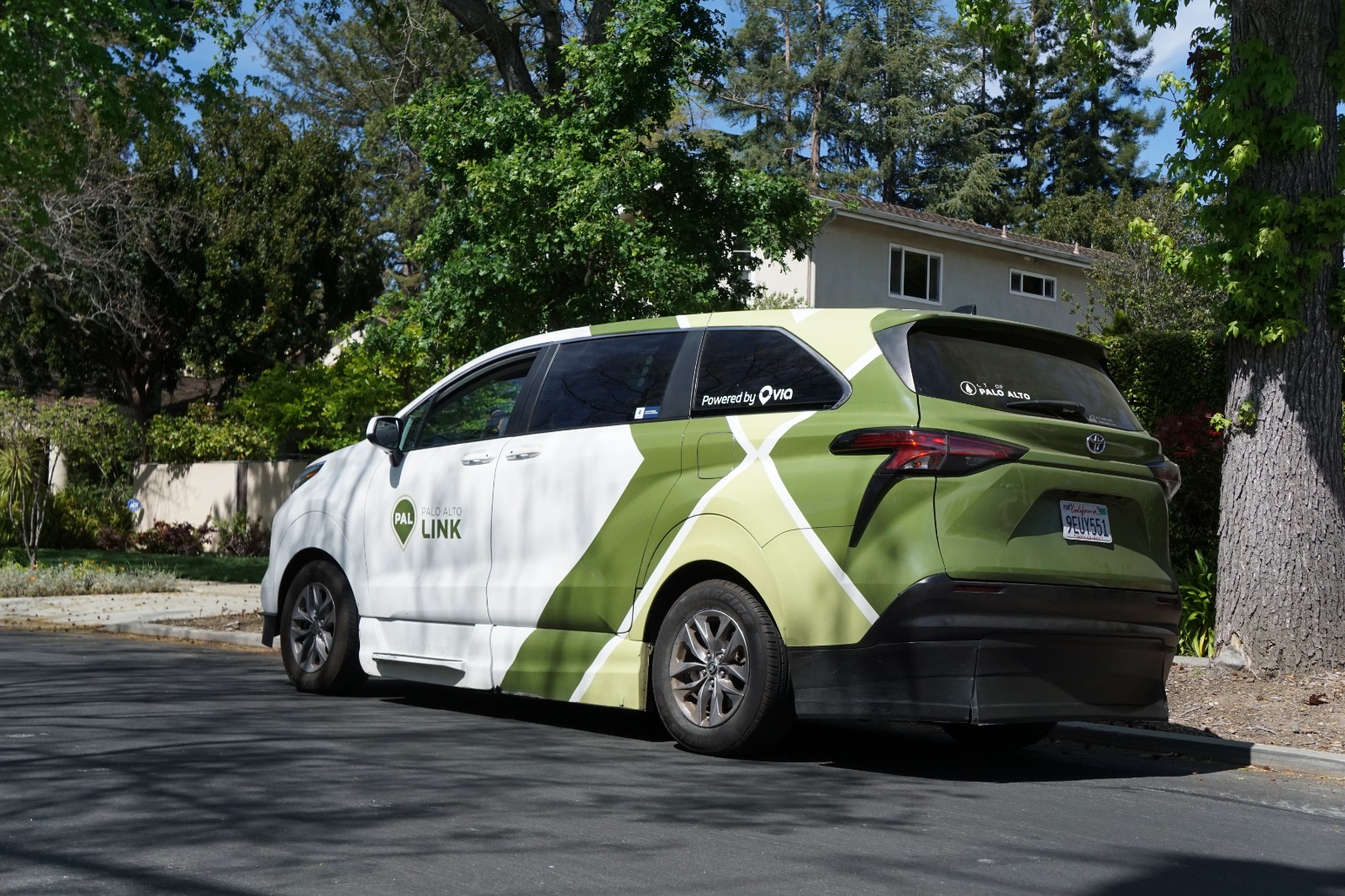
Because of reduced grant funding and declining ridership, the Palo Alto City Council discussed the potential of no longer funding the local ride share program Palo Alto Link after June 30.
According to Palo Alto Chief of Transportation Ria Hutabarat Lo, the City has invested in many low-cost modes of transportation over the years, including the Palo Alto shuttle, as well as partnerships with transit agencies, including the Valley Transportation Authority, San Mateo County Transit District and Alameda-Contra Costa Transit District.
However, Hutabarat Lo said the Palo Alto shuttle shut down during to COVID due to lack of ridership and decreased funding, which led to the creation of Palo Alto Link.
“The City had previously had an interest in exploring a kind of on-demand service, so the Palo Alto link provided that after the shuttle service stopped,” Hutabarat Lo said.
According to the City Council meeting notes from March 2, after COVID, the City staff submitted a successful application for $2 million in VTA Measure B Innovative Transit program funds for Palo Alto Link.
The system employed hybrid and electric vehicles to provide on-demand rides booked via mobile app or phone and had service hours from 8 a.m. to 6 p.m., Monday-Friday. The initial fare for adults was $3.50, with a discounted price of $1 for disabled, low-income, senior and youth riders, which has since increased to $4 and $2, respectively. The hours of operation also recently changed to be 7 a.m. to 7 p.m.
Junior Alice Zhan said while she appreciated the Link’s low fares, the system had its drawbacks.
“It’s good because it’s a dollar for a ride, so it was cheaper transportation than Uber,” Zhan said. “But it wasn’t amazing because the wait time for it was really long.”
Junior Riddhi Bansal agreed.
“The waiting times would be crazy — it would be as much as 30 minutes,” Bansal said. “Sometimes it would do this thing where your driver would be 30 minutes away, and then you’d close the app and open it again two minutes later, and all of a sudden they’re five minutes away, which kept me on my toes.”
Along with delayed pickup times, Bansal said she had other issues with the Palo Alto Link app.
“There are actually a lot of glitches,” Bansal said. “Sometimes the driver would switch up on you midway, but there aren’t many drivers, so that usually wasn’t an issue. But sometimes I would have problems with drivers where the pickup and drop off destinations are never directly where you are. You always have to go some distance to get to your drop off point and your pickup point.”
Transportation Planning Manager Nathan Baird said the distance from one’s true requested location is due to maximize efficiency and sustainability.
“Palo Alto Link is currently designed to pick up and drop off riders at an intersection near their requested locations as a way of making the ride more efficient for pooled rides,” Baird said. “Direct address-to-address rides are available, but only for disabled and senior riders. This helps the service replicate the efficiency of transit services.”
While the Palo Alto Link provides rides from 7 a.m. to 7 p.m on weekdays, Bansal said another deterrent to ordering a Palo Alto Link is the limited operating hours during school pick up and drop off times.
“There’s also another issue where, from 7:30 to 9, they don’t allow they don’t let you get dropped off to school, and then from 3:30 to 5, they don’t pick you up from school because the demand was too high, and they did not have enough drivers,” Bansal said.
Junior Jewon Shin said her parents prefer the decreased risk of accidents from self-driving Waymos compared to an Uber or a Palo Alto Link.
“They actually want me to take Waymo a bit more often nowadays because they’re concerned that the drivers might be a bit unsafe,” Shin said.
With no potential transportation subsidies lined up to replace Palo Alto Link funding and a tight city budget, members of the City Council say the program may not last much longer.
“Last year, staff encouraged the Council not to close it at the end of the year, which was their original direction, and to extend it to the end of this fiscal year — that would be June 30 of 2026,” Hutabarat Lo said. “However, when we went to council on March 3, they expressed a different sentiment, which was that they would like to investigate options, and specifically, one of the options that they suggested was some sort of Uber or Lyft subsidy.”
With the potential loss of Palo Alto Link and despite some of its drawbacks, Shin said riders who rely on the service will be negatively affected.
“I think that would be very tragic news to a lot of people who use it,” Shin said. “It’s a great system since it’s very cheap, and it’s an efficient system where if you aren’t trying to get to your destination as fast as possible, then it’s a big save of your money.”
Ultimately, Hutabarat Lo said the best transportation replacement solution will take into account more community input and perspectives.
“We’re trying to build a system that is space efficient, that aligns with our values as a community and that is effective and uses resources wisely,” Hutabarat Lo said. “It’s a whole community and whole city effort, both in terms of us trying to improve the facilities that are there, to provide services and to advocate services from the regional transit providers, but it’s also decisions that we make individually and collectively.”