
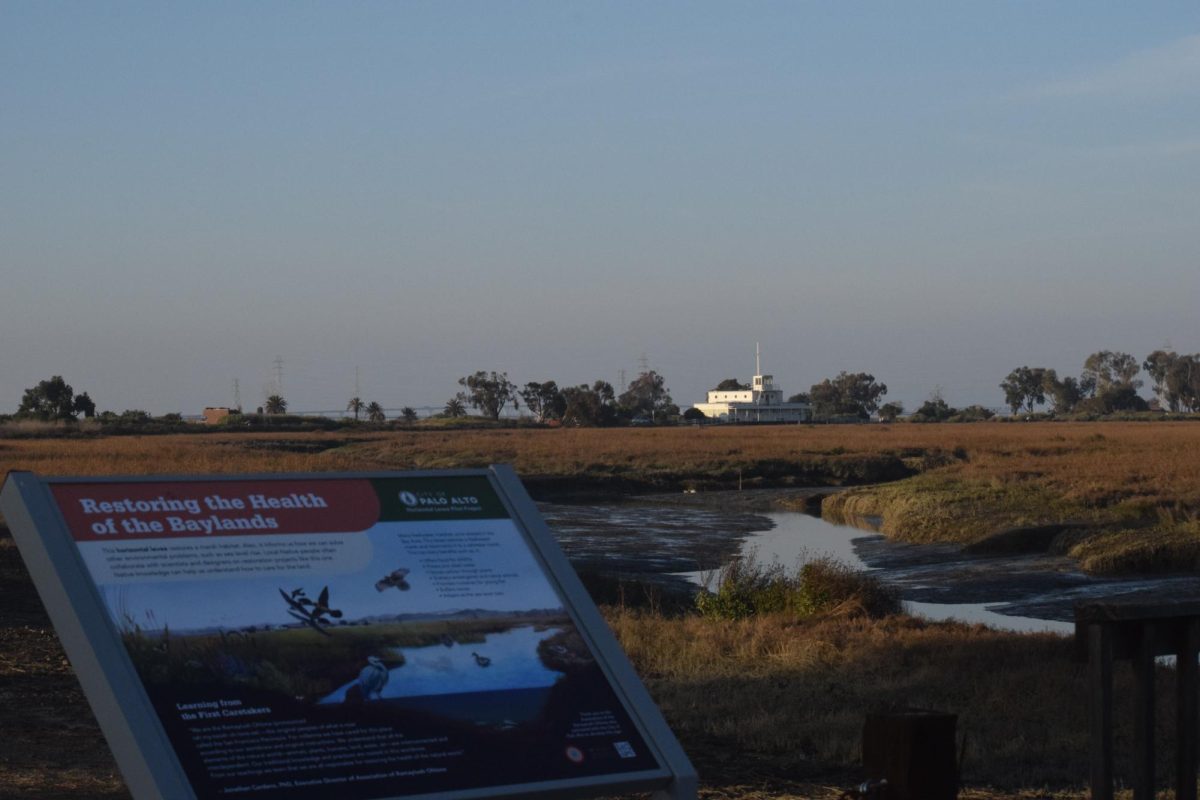
Grass. Soil. The kind of ground you’d expect in a garden, a playground, or the Quad — not the thin line protecting a city from flooding. But at the Baylands Natural Preserve, that’s exactly what it is. Along the marsh’s edge, east of Byxbee Park and across from the Palo Alto Regional Water Quality Control Plant, the City of Palo Alto is building a horizontal levee made of grass and soil.
“A horizontal levee is a gradually sloped vegetated berm that uses native vegetation to slow water,” said Samantha Engelage, Project Manager and Senior Manager for the City of Palo Alto.. “It builds up sediment over time and protects infrastructure behind the levee from flooding.”
Heidi Nutters, Principal Program Manager at the San Francisco Estuary Partnership and a partner on the horizontal levee project, said the city at first regarded the project as a novel approach to shoreline protection.
“This project came out of an experimental design in the East Bay at the Oro Loma Sanitary District,” Nutters said. “We were looking at how we could address sea level rise and water quality improvement in the same project.”
One of the driving factors for Palo Alto to launch its own horizontal levee as a pilot project was the experimental success at Oro Loma.
“We’ve been monitoring it for about 10 years and found that the microbial activity in the soil removes nutrients and contaminants of emerging concern from the wastewater,” Nutters said. “The project uses a wetland system where treated wastewater is pumped through soil and native plants, allowing microbial activity below ground to remove nutrients before the water is returned to the treatment plant.”
Additionally, Engelage said the horizontal levee may be a better option than traditional levees.
“It uses treated wastewater to irrigate the vegetation,” Engelage said. “Not only does this type of system protect from flooding, but it also provides diverse habitats and additional treatment of treated wastewater.”
However, Nutters said the nature of the project as a pilot program made it difficult to implement.
“It’s the first of its kind, so there wasn’t a paved path for how we were going to do a lot of this,” Nutters said.
Additionally, Nutters said funding and acquiring permission for the project brought its own set of challenges.
“We had to be really creative with where we got funding for the project, and we had to be really scrappy, honestly, with how we put different funding sources together,” Nutters said. “It was also pretty challenging to get permits for a project like this.”
Nonetheless, despite the possible challenges of the project, the city is optimistic the living levee can deliver multiple benefits.
“If water goes over a seawall, your asset is flooded,” Nutters said. “A wetland has more of a buffering capacity that meets the water as it moves across the landscape.”
In order to ensure the project would effectively aid surrounding cities, Engelage said Bay Area communities were represented in decision-making and were able to voice their feedback.
“We’ve tried to engage the community throughout the project,” Engelage said. “During design, we had different workshops with stakeholders to get feedback on what the community wants to see out there and hear concerns they may have.”
Engelage said indigenous communities and volunteers were also involved.
“The Association of Ramaytush Ohlone helped us develop interpretive and educational signage at the project,” Engelage said. “We engaged Save the Bay to bring the community to the project site to actually install the 2,000-plus plants needed to vegetate the levee.”
Volunteers from organizations such as Save the Bay also played a crucial role in the effort by installing native plants to vegetate the levee.
“The way we do this kind of replanting involves a lot of volunteers, and that gives people who live in the area the opportunity to be a part of restoring the Bay in a hands-on way,” said David Lewis, Save the Bay’s Executive Director. “People feel more ownership and responsibility for it, and they understand how nature works much better than if they were just reading about it in a book.”
Because of the large volunteer support for the project, Lewis said the work is carried out efficiently and at a significantly reduced cost.
“It would be very expensive to hire professional contractors to do the kind of work that we do for a fraction of the cost,” Lewis said. “More work gets done for a lower cost.”
In addition, Nutters said the project can support communities that are often most impacted by poor water quality.
“We’re learning how to be proactive and adapt so flooding doesn’t disproportionately impact marginalized communities,” Nutters said.
For local residents such as Palo Alto High School sophomore Jacob Guhr, the project brings stability to a place with personal meaning.
“The Baylands is my beauty and relaxation place,” Guhr said. “Everywhere you go, it’s colors everywhere. I’d hate to see it get flooded.”
For the city, Nutters said the project’s success is measured in how people engage with the Baylands and how it can potentially influence ecosystem services in the future.
“Success over the next few years for the project would look like the habitat getting established, people accessing the site and enjoying the site and engaging with it,” Nutters said.
If the horizontal levee project in the Baylands proves successful, the city may expand it to a larger scale.
“(The project is) testing whether all these benefits can actually come together in one project,” Lewis said. “Most places around the Bay Area where there are sewage treatment plants are where this kind of living levee could be possible.”
For residents interested in the levee, there will be ongoing opportunities to participate and help sustain the shorelines at the Baylands.
Engelage said, “Once the project is completely finished, there will be several opportunities for the community to get involved through community science events, volunteer activities and outreach coordinated through the city and our partners.”
