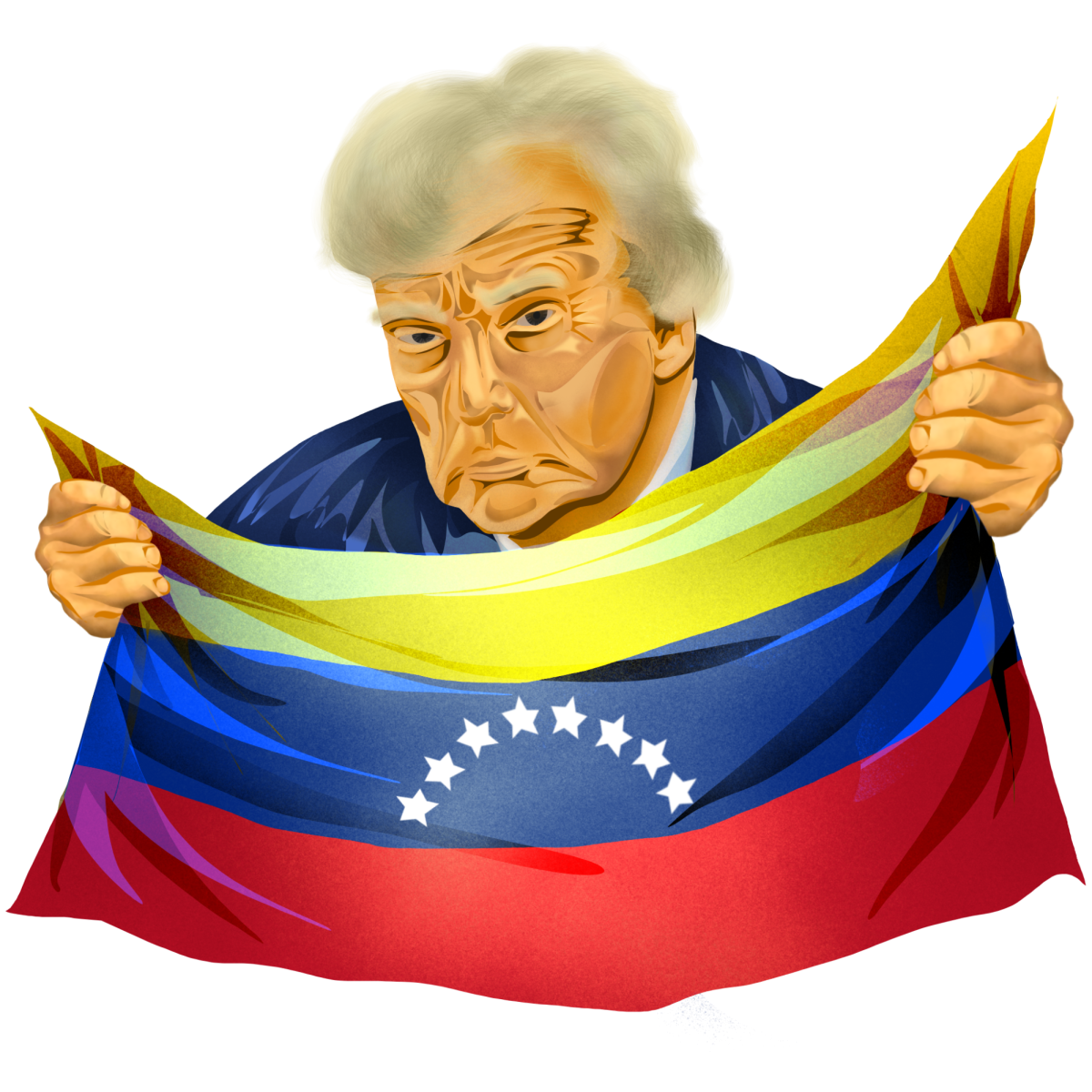
President Donald Trump announced the successful capture of Venezuelan dictator Nicolas Maduro and his wife, Cilia Flores de Maduro, from the Venezuelan capital Caracas on Jan. 3 Jan. 3.
According to Trump, Operation Absolute Resolve, the name given to Maduro’s capture, was based on charges of narcoterrorism and drug trafficking.
Foreign Policy teacher Adam Yonkers said the United States’ decision to remove Maduro is problematic due to the United States’ explicit values of supporting the sovereignty of other nations.
“If we’re exercising the defense of sovereignty elsewhere – places like Taiwan— and you go in and seize those assets and remove the leader, that can be seen as setting a precedent,” Yonkers said.
Venezuela has some of the biggest oil reserves in the world. According to Trump, the United States plans to extract the oil from Venezuela to be refined and sold in the United States.
“Venezuela has also agreed that the United States will immediately begin refining and selling up to 50 million barrels of Venezuela crude oil, which will continue indefinitely,” Trump said in a press conference. “We’re all set to do it.”
Yonkers said he thinks oil reserves were the main reason for Maduro’s capture, rather than Trump being focused on Venezuelan citizens.
“Quickly following up with meeting with oil executives (after the capture of Maduro) has shown that they’re very interested in the oil,” Yonkers said.
Junior Maria Uribe said she thought it was good that the United States removed Maduro from power, due to his policies affecting the well-being and quality of life for many Venezuelan citizens.
“Maduro was an authoritarian leader,” Uribe said. “He stole the elections and kept Venezuelans impoverished and politically oppressed. Trump has been one of the few leaders willing to take action against his repressive regime. Whatever you think of his broader agenda, at the end of the day, he’s given Venezuelans hope that change is possible, something they haven’t had for a long time“
But junior Neel Satyavolu said he sees little progress made through the removal of Maduro because many of his cabinet members still have power and influence in the Venezuelan government.
“I think removing him as an isolated goal was good, but I think that we never should have done it in the first place, because it’s not really going to change much,” Satyavolu said
In 2024, despite overwhelming evidence to the contrary, Maduro did not acknowledge his loss of Venezuela’s democratic election, causing the opposing leader, Maria Corina Machado, to go into hiding for 11 months, before emerging – following a daring US backed extraction– in December to receive a Nobel Peace Prize in Oslo.
After the removal of Maduro, Machado presented her Nobel prize to Trump as a recognition of the United States’ removal of Maduro.
Uribe said she hopes Maduro’s opposing leader and true winner of Venezuela’s 2024 election Maria Corina Machado would return to Venezeuela to re-unify the nation and bring back peace for the people.
“I hope Machado returns to Venezuela soon,” Uribe said. “After having to hide for so long she can lead Venezuela to a better future.”