
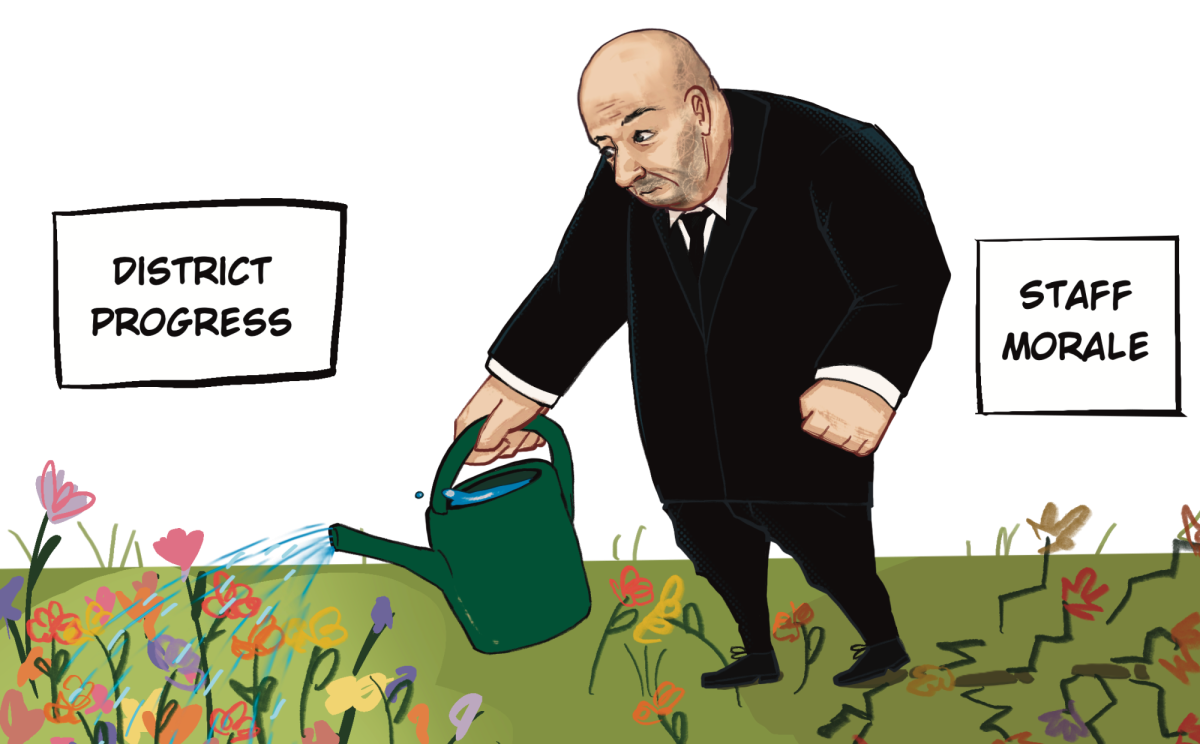
In a Feb. 20 letter from School Board President Shounak Dharap, The Palo Alto Unified School District announced Don Austin would no longer be serving as district superintendent, effective immediately. The letter called the decision a mutual agreement and said this was not a retirement or a termination.
Leading up to the mutual separation, PAUSD was embroiled with conflict. At the Feb. 10 board meeting, heated debate took place over salary negotiations and district management’s decision to cut elementary reading specialists, copy technicians and other support staff positions for the 2026-2027 school year.
Tensions also boiled over in a public, verbal confrontation between Austin and Paly School Board Representative Dylan Chen. When Chen reflected on a past conversation where Austin argued for staff cuts to account for salary raises requested in teacher union negotiations, Austin sharply criticized Chen’s comments and said he had “grossly” misrepresented the situation. After Chen responded by saying that he was only trying to represent student body concerns, Austin eventually left the meeting altogether.
The Campanile acknowledges — and is grateful for — the years of service that Austin has dedicated to the district. As the longest serving superintendent of PAUSD since 1975, he navigated the COVID-19 pandemic and brought measurable advancements in both equity and academics, among other things.
We would also like to acknowledge Austin’s positive efforts for community outreach. Austin welcomed a student advisory board, where he listened to and amplified student voices by sharing student opinions at the start of every district-wide email he sent out. We would have liked to see this inclusion effort expanded to reach a more representative sample of the student body, but regardless, his effort is commendable, and we encourage our future superintendent to follow suit.
Still, despite his many successes and contributions to the district, we believe the mutual decision for Austin to leave was the right step forward. Recently, Austin has communicated with hostility towards staff and students alike, exemplified by the interaction with Chen. This is particularly concerning in a time where the district is already pushing to create a more positive and supportive environment for students.
Beyond his personal conduct, he has often made decisions quickly, without consulting the communities affected, and has responded with similar contempt when faced with pushback. For instance, his since-overturned decision to significantly reduce the number of reading and ESL specialists at elementary schools would inevitably roll back recent demonstrated gains in reading levels, result in higher misplacement of English learners into Special Education pathways and lead to lower student equity outcomes, yet he was resistant to feedback that expressed these concerns.
Similarly, after the initial announcement of staffing cuts, Paly teachers launched a campaign to save the job of Copy Technician Veronica Rodriguez, who they said was an invaluable member of the Paly staff and whose work directly impacted their ability to teach well. In his email responses to teachers expressing their concerns, he was both aggressive and dismissive of their worries.
His disregard for educator insights mirrors past decisions, including the move to create the Advanced Diploma in September 2025. To receive the Advanced Diploma, students would have needed to get an internship, complete the AP Capstone requirements and have qualifying standardized test scores — all metrics more strongly correlated with income than student potential.
Just as with more recent decisions, Austin announced the initiative without consulting AP Capstone teachers, who had worked so hard to diversify the pathway and make it accessible to first-generation and low-income students. This was yet another instance in which he prioritized district image over real implications regarding equity, student mental health and the wellbeing of the entire AP Capstone pathway.
Given all of this, it is unsurprising that he has a fractured relationship with many teachers. Palo Alto Educators Association president Todd Culbertson wrote in a statement following the announcement of his departure that “(t)he damage to morale and the erosion of professional trust cannot be ignored,” and The Campanile agrees with this wholeheartedly.
Teachers are the heart of this district: they are experts who plan lessons, teach classes, grade assignments, cultivate relationships with kids and support students both academically and personally through every step in their educational journeys — often on top of long commutes because of the incredibly high living costs in Palo Alto. Our teachers deserve to be treated with respect and dignity by leaders in the district.
We acknowledge that PAUSD is an incredibly intense community to work in, and the job of a superintendent is never an easy one. We understand that Austin was often navigating very public, complex and demanding situations to the best of his ability, and that the Palo Alto community’s entitlement can make it nearly impossible for a superintendent to please the community. Still, it is the job of any leader to communicate respect and empathy when working through disagreement, especially when it concerns the people who work for them. A top-down mandate leadership style doesn’t make PAUSD a strong community, it is the people who work daily on campuses and in classrooms who do.
To our future superintendent and the Board of Education:
We hope to have a leader who is collaborative, kind and transparent and who responds to feedback with thoughtfulness.
PAUSD can be a complicated, challenging district to lead, but we’re also an incredibly diverse, passionate and vibrant community. We hope you take the time to get to know us in authentic ways — on campuses, on sports fields, in classrooms and theaters. We hope we can bring our concerns to you and feel heard, and that you are someone who listens to everyone, not just the most vocal or resourced members of the community.
Most importantly, we hope you are invested in building positive relationships with district staff, students and the wider community. Our teachers, in particular, bring an astounding amount of expertise, passion and dedication to their classrooms, and we hope you value their opinions. They understand, on an acute level, the inner workings of the schools, and their perspective should never be overlooked.
We recognize that avoiding disagreement is unrealistic, especially in a district with such complex dynamics. We don’t expect perfection or even to always agree with decisions you make — we understand that it’s impossible to please everyone, and sometimes an unpopular policy is still the right decision.
What ultimately defines a good leader is not how they carry themselves in times of success; it is the approach they bring to navigating conflict. We hope you are a leader who brings the temperature down. We urge you to listen to those around you; to experts, to teachers, to community members and students before making decisions.
To our community:
We recognize a culture shift is only possible with the support and dedication of the entire district, including students, families, staff and administration. Not all responsibility and blame can fall on the superintendent when things don’t go right. Taking on the task of becoming a good superintendent in our district is nearly impossible in our current state of aggression, entitlement and lack of proper civic discourse.
When the new superintendent gets appointed, we urge individuals to have patience. Above all, we call on the wider PAUSD community to practice empathy and to approach disagreement with thoughtful civility. This is not to say feedback shouldn’t be given; rather, we must approach disagreements with expectations of mutual respect, and realize that the superintendent, too, is human.
And to the current PAUSD administration:
Leadership isn’t just defined by numbers and results. It’s also measured by the relationships you build with the community you lead and the dignity you treat others with.