
Senior Sarah Thieman sat cross-legged on her bedroom floor during the second semester of her sophomore year as she and her best friend unpacked a cheap Amazon stick-and-poke kit, a DIY tattoo method that uses a needle instead of a machine.
Bored and wanting to do something spontaneous, they landed on giving each other matching red heart tattoos — simple, colorful and different from the typical stick-and-poke designs they had seen. Her friend goes first, poking the needle into Thieman’s inner wrist, and then Thieman does the same back.
“Sophomore year is when you’re branching out and, in every aspect of my life, I was in the mindset where I wanted to be spontaneous,” Thieman said. “We were just bored, and then we were like, ‘We’ve always wanted to get something matching — this will be so cute.’ It just was a bonding experience, and we both were like, ‘It’s just temporary. We’re not going to really regret it.’”
Thieman said she and her friend designed and gave each other several more tattoos over the next few weeks.
“Once we did that, we were addicted,” Thieman said. “We were like, ‘Oh my gosh, let’s just keep doing them. These are so fun.’ Sometimes, I think these are so stupid, but it’s fun to look back on them and remember them as little memories. My friends would see them and want them too — they’re great conversation starters.”
Thieman’s experience reflects a broader shift: tattoos have become a mainstream form of self-expression for adolescents, with studies showing 10-23% of teens already have them and over half of those without expressing interest. While social media has accelerated the trend by normalizing ink as casual, creative and low-stakes, DIY stick-and-pokes carry added health risks — including bacterial infections and bloodborne diseases like Hepatitis B, C and HIV — due to lack of sterile equipment and professional technique.
Thieman said platforms like Pinterest and TikTok have played a big role in introducing her to tattoos and normalizing them for people her age. She said social media helped her feel more confident in her choices and made tattoos feel less serious.
“If I scroll on a video and I see someone who looks super pretty and cool with tattoos, I’m like, ‘Wow, now I want that,’” Thieman said. “In your everyday life, you may not see many people with tattoos, so you think it’s crazy and not normal, but on social media, you see all these different types you can get. It doesn’t have to be one type of person to get a tattoo, it can be anybody.”
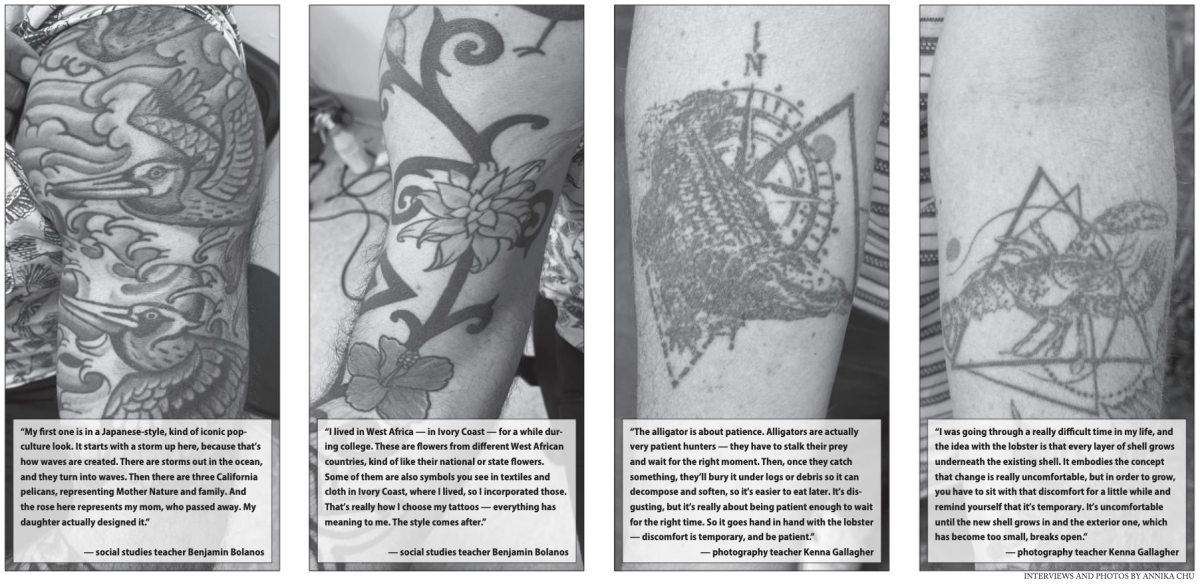
History teacher Benjamin Bolanos, who has ten tattoos, said they are a powerful form of self-expression.
“It’s an art form,” Bolanos said. “It’s what’s interior that becomes exterior. It’s a form of showing who you are to other people. I think it’s also beautiful. I don’t usually pick random tattoos. I definitely think through what I want and if it’s meaningful or not.”
Senior Iverson Lee said his half-sleeve dragon tattoo, inspired by his father’s koi dragon tattoo, carries deep personal and cultural significance. In a Chinese legend, a persevering koi fish swims upstream, endures hardships, crosses a waterfall and is rewarded by the gods with transformation into a dragon.
“My dad told me that story when I was younger, and it’s something that’s always stuck with me,” Lee said. “That’s why I wanted to get this tattoo. Being Asian-American is a very big part of my identity, and it’s something I’m very proud of, so I wanted something to also represent that.”
Photography teacher Kenna Gallagher said they approach tattoos as an extension of their passion for art.
“It’s just another art form,” Gallagher said. “I consider myself an art collector … A lot of my tattoos were co-designed, and I’d say about a third to a quarter of my tattoos are my personal drawing designs.”
Even though tattoos are more accepted now, Lee is still cautious of judgement and intentional about the placement of his tattoo.
“I purposely chose the spot on my arm and my chest so I can cover it with a T-shirt,” Lee said. “Right now, at this age, when I’m going to school and eventually looking for a job, people might have preconceptions about people with tattoos and might look at them negatively. So until I have a career, I feel like personally, it’s important to be able to cover them.”
And Bolanos said there are generational and cultural differences in how tattoos are viewed.
“Older generations definitely viewed them differently,” Bolanos said. “It was associated with criminal elements, at least in American society. We’re also a very puritanical society, where different religions forbade tattoos on the body. They’re seen as desecration.”
However, Balanos said in some other countries and cultures, the practice of tattooing has existed for centuries.
“It’s a very human thing to do — to mark yourself in some way or another,” Bolanos said. “If it’s not tattooing, we’re always doing body modification, whether you pierce your ears or change your hairstyle. So I don’t see it as any different than that.”
Thieman, who has multiple small stick-and-poke tattoos, said she will likely continue getting small, subtle designs that are easy to hide.
“It’s just a tiny little thing on your skin,” Thieman said. “I didn’t really care about what other people thought about it. Also, it’ll be a funny story to tell because every single one that I have is attached to some sort of story — not that they have meaning, but there’s a memory attached to it, so it’s always just a fun story to tell.”
Now that she is legally able to get a tattoo, Thieman said she wants to get a more permanent, intentional design.
“Now that I’m 18, I definitely want to go get a real tattoo, but this time I want it to be a lot more meaningful,” Thieman said. “There’s some questionable ones, but most of the time people with tattoos either have beautiful artwork or there is a meaning behind them, or it’s just part of their style. It’s a really cool way for people to express themselves.”
