
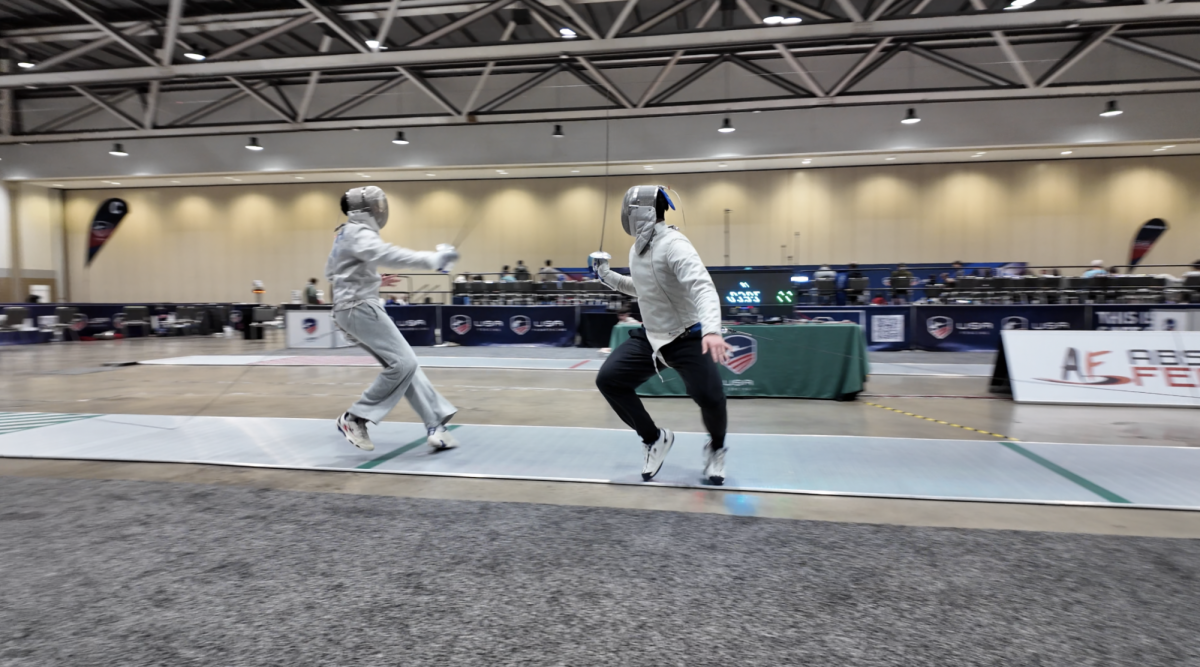
The sound of steel on steel rings through the air as junior Richard Klinkner lunges and parries his opponent’s attacks, seeking to land a hit and score a point.
Behind the masks and white jackets, Klinkner is part of a growing number of students in the Bay Area who find both competition and community in fencing.
“I would call it directionally challenged,” Klinkner said. “You have to make a lot of fast movements … I think the swords make it pretty unique.”
Fencing traces its history back to ancient Egyptian swordsmanship, but the modern sport was refined during the Renaissance by the Italians and later the French.
Nicolas Rousset, a former French national team fencer who now coaches a club in Burlingame, said fencing is, first and foremost, a combat sport.
“It’s an opposition sport, a fighting sport,” Rousset said. “It’s like boxing with a weapon.”
But unlike other combat sports, fencing doesn’t involve the use of one’s fists. Instead, it features specialized blades.
Specifically, fencers have the opportunity to choose between three types, each with their own distinct strategies: foil, épée or sabre.
“The three weapons are for different tempers,” Rousset said. “Épée is for people who like to take their time, elaborate on strategy and don’t rush. Foil is a mix of épée and sabre. It’s a little bit faster. Sabre is the quickest one, where you need to make very quick decisions in a very short time for your tactical strategy.”
Sophomore Henry Chan, a sabre fencer, said fencers score points when their blade makes contact with an opponent’s target body area, although the targets vary between each of the three blade types.
“I fence sabre, so my target area is waist up, including the head and arms. It’s the fastest one, and the only one where you can slash your opponent instead of poking them,” Chan said.
Chan said the sport’s fast-paced nature and unique tactics make it distinctive.
“Fencing (is) very unique because it requires a lot of speed and explosiveness,” Chan said. “But fencers aren’t necessarily in the standard running position. It’s more of a crabwalk, where your front leg is facing forward and your left leg is at a 90-degree angle.”
The tools of the trade are also appealing to fencers like Klinker.
An épée fencer, he said the blades were part of the reason he picked up the sport.
“I think the swords make it unique,” Klinkner said. “I first got into fencing about five years ago, partly because I thought swords were cool.”
One aspect of fencing that has contributed to the sport’s popularity in the Bay Area is its beneficial impact on college admissions, Klinker said.
“I do think it gets enough recognition in that colleges just love it,” Klinkner said. “I got into fencing because I was trying to college farm.”
Rousset said fencers compete at national tournaments where athletes can attract the attention of and network with college coaches.
“With national competitions, you have a ranking, and the universities base their (recruiting) criteria on these national rankings,” Rousset said. “At these national competitions … you have coaches from the universities who are there and can see and talk with fencers and parents to prepare an interest in their university.”
However, Chan said this pressure to impress coaches and do well at tournaments can be excessive.
“There’s a constant pressure on you, because the Bay Area constantly has pressure from school and competition and parents, but especially in sporting events,” Chan said.
Celine Chang, a freshman on UC Berkeley’s fencing club team who also fenced in high school, said the tradeoff between focusing on fencing and her academics ultimately pushed her away from attempting to get recruited for the sport.
“I realized that the pool of people that these high-level coaches are looking for is just for what I wanted to do, like academically, and just like what I wanted to have as a student, not sustainable for me,” Chang said. “Another thing that dissuaded me from that process was, when you’re trying to get to that level and be noticed by coaches … you feel that pressure to perform and give certain results, and I think that sucks the joy out of it.”
Chang also said fencing can be expensive, illustrated by its association with the upper class and costs that can reach thousands of dollars.
“If you’re participating in a regional tournament, registration is $50 to $100,” Chang said. “Equipment – if you break something – that’s at least a couple hundred dollars, and if you lose something, you have to buy that again. Also, travel. I’m from NorCal, but we would go to SoCal a lot for competitions. So whether it be gas money for driving, or flights …. the hotel … minimum, for a travel competition, even within California you have to spend $500. The maximum is probably in the thousands, which sounds crazy, but that’s the reality of it.”
Regardless, the sport shows no sign of decreasing in popularity.
Internationally, in 2023, the Junior and Cadet World Championships drew more than 1,500 athletes from 100 countries, an 11% increase from the year before and the largest turnout in the event’s history, according to the International Fencing Federation.
This growth is exemplified locally too.
“The sport’s growing a lot. A lot of new clubs are opening in the Bay Area,” Rousset said. “I think we are the club who’s opened the most recently. But you already have some very big clubs existing in San Francisco, in San Jose, in The Peninsula.”
Rousset said demand is what drew him to founding a club in Burlingame, which originally had no place for fencers to develop their skills.
“There were no clubs where we were,” Rousset said. “So we are trying to develop it here.”
Rousset, a fencer with overseas experience, also said many coaches from around the world are flocking to the United States.
“A lot of coaches from everywhere in the world are coming to the USA,” Rousset said. “And when you have more coaches, you have more clubs.”.
And despite the expectations placed on athletes, many still genuinely enjoy the sport. Now in college, Chang said she appreciates fencing on Berkeley’s club team, especially due to the lower stress.
“The difference between college and high school is that it’s just a lot more relaxed and chill,” Chang said. “We don’t really care that much about results or anything. It’s really just to go and fence and have fun and learn together.”
That aspect of learning and fencing together within a community is also what keeps Klinkner in the game as a high school fencer..
“What made me stick with it was the magnificent community,” Klinkner said. “I’ve made lots of good friends, and I’ve met lots of amazing people.”
Rousset, too, said the people are the reason he coaches.
“I love the sport. I love what it brings to you as an athlete, but also as a human,” Rousset said. “The values of the sport too, with the respect and giving everything you have to make it happen. And I became a coach because I love to … have interactions with people.”
