
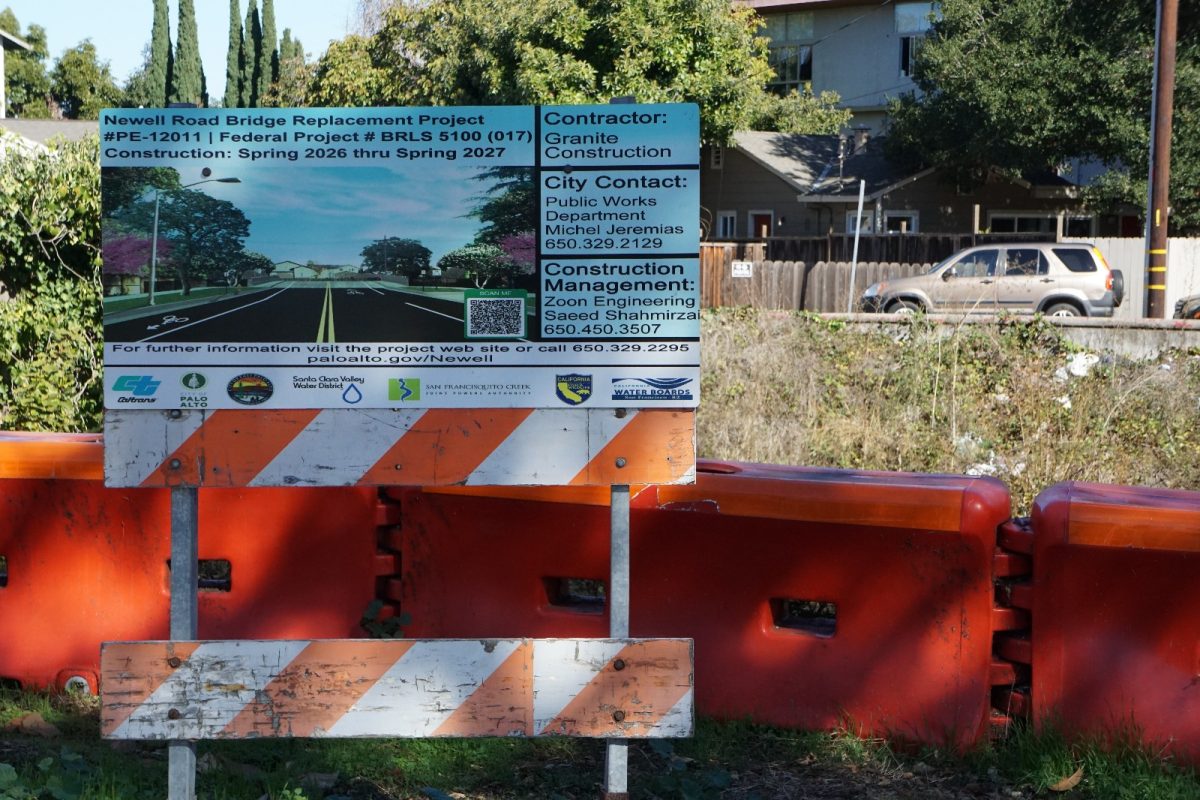
The San Francisquito Creek Joint Powers Authority held an informative and participatory Zoom meeting on May 28 to discuss flood prevention measures in response to resident concerns surrounding neighborhood flood risks. The meeting was open to all Palo Alto community members
In recent years, flood risks have been an issue, especially in the Crescent Park district.
One incident in 1998 resulted in a record flooding of 7200 cubic feet of water per second, damaging over 1000 homes in that area.
Palo Alto resident Thomas Rindfleisch said he and his neighbors were personally affected by that flood, including loss of furniture and equipment used to operate homes.
“We had a foot and a half of water in our yard,” Rindfleisch said. “The streets were lined with ruined furniture and carpeting and all sorts of contents of houses that had to be destroyed and replaced in order to make them livable.”
The JPA, formed following that flood, consists of five representatives from Santa Clara Valley Water District: East Palo Alto, Menlo Park, the San Mateo County Flood and Sea Level Rise Resiliency District and the City of Palo Alto.
Margaret Bruce, the Executive Director of the JPA, said her organization coordinates money from grants, other kinds of funding and financing, and consultants and technical experts who advise us on ways to approach these kinds of complex projects.
“We’ve known about this problem forever,” Bruce said. “Two counties and three cities have a really hard time agreeing amongst themselves, so the JPA was formed as a place to be one table where five musketeers could come together and hash out their conundrums, their problems, their conflicts, their ideas, put money into a pot together to run the organization.”
According to Bruce, flood zones can be ranked into several categories including 1 in 100 floods, 1 in 75 floods and 1 in 50 floods, with the numbers representing the frequency in a certain number of years, among others.
“It’s a kind of calculation that is bigger than a bread box, smaller than an elephant,” Bruce said. “Every flood, every storm, is different, because the channel has many chaotic variables.”
According to the Federal Emergency Management Agency, Crescent Park is categorized as an AH zone, which is an area likley to get fairly shallow flooding of less than three feet depth. The flooding source of the AH Zones in Palo Alto is overflow from the San Francisquito Creek.
In response to this, former mayor Greer Stone, now the Palo Alto representative to the JPA said the JPA board unanimously approved a flood mitigation goal of achieving a creek capacity that would prevent accidents similar to the one in 1998.
“In order to achieve that goal, we will need to use a variety of strategies,” Stone said. “Our own consultant has confirmed that no one strategy will achieve the 7,200 cubic feet per second goal, so it is likely that some version of flood walls will be necessary in certain locations along the creek, but the size and extent of those flood walls are still to be determined.”
One proposed solution was to build flood walls in Menlo Park in order to resolve the danger at the stem of the problem. However, Stone said this plan may be harmful to the citizens living there.
“While structural measures like flood walls can provide protection, they also raise valid questions about environmental impacts, aesthetics and equity between communities,” Stone said.
Similarly, Bruce said the construction of the walls in Menlo Park would negatively impact the people with properties along the creek in Menlo Park by invading the space with disturbances, such as dust, noise, vibration and traffic.
“The people who are benefiting from the project do not have the impacts of construction,” Bruce said. “All of the people along Woodland Avenue and Palo Alto Avenue will have impacts of construction, and they don’t benefit from the project. It’s a tragedy of the commons problem.”
As a result of these detriments, community members have looked for more viable solutions, one of which is Rindfleisch’s proposal to repair the Pope-Chaucer Bridge, which he said has become similar to a dam with a big hole in it.
“It isn’t a question of putting some band-aids in the creek,” Rindfleisch said. “It has to be a systematic project that takes everything from Highway 101 up to replacing the Pope-Chaucer Bridge in order to really upgrade the creek so that it could handle the 1998 flood.”
Without a definite solution, Bruce encourages community members to remain vigilant and take precautionary measures, such as helping neighbors, ensuring storm drains aren’t clogged and making sure people have basic emergency preparedness against future catastrophes.
“Until this is finished, everybody needs to be aware of the risks and protect themselves,” Bruce said. “The chances of there being a life-threatening flood are very, very small. The chances of there being a property damaging flood are more significant. But it doesn’t mean there’s no impact at all. So be prepared.”
