
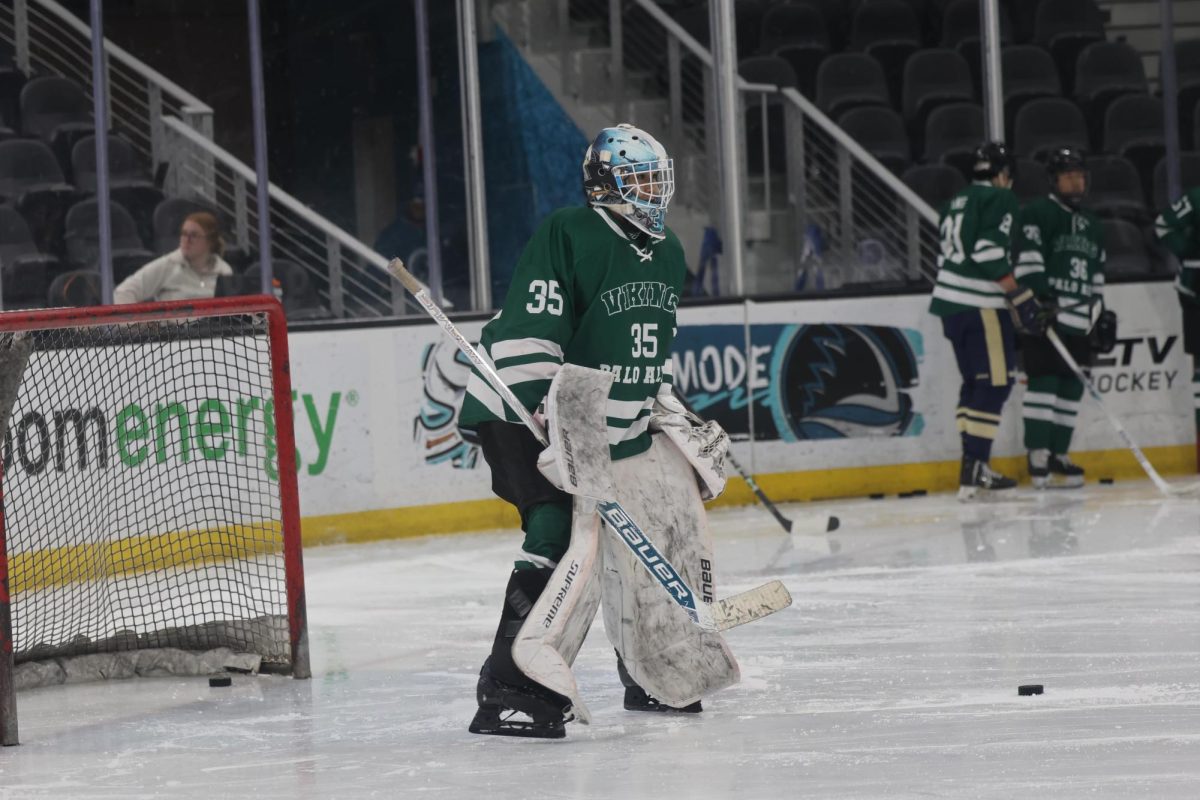
As junior Miles Joing skates into the ice rink, he leaves the pressures of his homework, tests and quizzes behind and focuses entirely on the puck. Joing said he has enjoyed his time on the hockey team since he first joined over two years ago.
“Even though we didn’t make playoffs my freshman year, it was really fun to play with all of the upperclassmen and learn from them,” Joing said. The Palo Alto Ice Hockey team is not an official school sports team, as ice hockey is not governed by the California Interscholastic Federation. Instead, the team competes in the Sharks High School Hockey League, an independent hockey league that allows high school athletes to represent their schools on the ice. Because hockey is not a CIF-sanctioned sport, the team includes players from other local schools — including Mountain View, Serra and Menlo Atherton — to maintain a full roster.
Head Coach Craig Janik said one reason the team has been competitive from the start is this combined talents of players.
“The Vikings can draw players geographically from Palo Alto and San Mateo,” Janik said in an email. “It turns out that there are many very good players in this region — Club youth hockey is stratified by the competitive level B, A, AA and AAA, and the majority of the Vikings players played at the AA or AAA level.”
The league offers junior varsity and varsity levels. JV consists of three different divisions, primarily split by skill level to create a development model. Varsity includes district-created teams separated into North (eight teams) and South (seven teams, including Paly) conferences. Teams play league games within their conference before competing against the other conference for the league championship. Each season lasts approximately four to five months, beginning in September and ending in late January or early February.
Sharks High School Hockey League coordinator Shane Galaviz said he has previously worked in other high school hockey roles and said this league is special because it offers high school-aged athletes the opportunity to play for their school or district.
“It gives them a chance to play the sport they love with people they see at school or live near them, whereas (in) travel (hockey), typically you see them at the rink for practice and that’s it,” Galaviz said. “Our league is an option for kids to play the game they love in a low-stress environment and have fun doing so.”
Junior Oliver Reid said this is a key reason he decided to try out for this year: everyone meshes together.
“One of the great things about the hockey community in NorCal is that it’s small enough where it feels like everyone knows each other, but big enough to be constantly meeting new people,” Reid said. “Because of this, so many people on our team have known each other for a while or played together before, but there were still a lot of players who got to get to know each other. Our locker room is really tight-knit and a great group to play with.”
This environment, Joing said, is created through familiarity, leading to the laid-back and relaxed nature of the games.
“When I get to the rink and into the locker room, everyone is having a good time and chatting,” Joing said. “Then, getting on the ice, our team just works so well together, which makes the whole experience a nice pause from school, among other things.”
Galaviz said this is also due to how the league is structured.
“(I want) to foster an environment where kids and families can begin, grow and maintain their love for a sport that I grew up playing,” Galaviz said. “I want everyone who joins this league to have fun and play with a smile on their face.”
Although freshman Stephen Yu — who currently competes at the AA/AAA level — is not on the high school team, he said he is interested in potentially joining.
“I currently play at a high level, so the pace and structure are pretty intense,” Yu said. “ (My decision to join) would depend on whether we could build a strong, competitive roster. I know at least one other Tier 1 player at Paly, and I wouldn’t be surprised if there are more strong players around.”
However, Joing said many students are unaware of the team because it is not officially recognized by Paly, making it harder for them to get involved.
“We don’t get publicity from the school, and we also have a lot of players on the team who go to different schools, so it’s hard to spread the word that we have a team,” Joing said. “Our Instagram account is moderately successful at showcasing our team, but one of our main goals next year is to grow the recognition of our team throughout Paly.”
Yu said hockey should be considered an official Paly sport because it challenges players both mentally and physically and demands significant dedication.
“Hockey requires just as much discipline, condition and commitment as any varsity sport — especially if you count 5 a.m ice time,” Yu said. “But we would also have the struggle of finding a (close by) ice rink that we could play at.”
Looking ahead, Joing said he is excited for next season. “Our team is looking forward to playoffs next year as we have made it the past two years, but we haven’t won the championship yet,” Joing said. “My goal for my senior year is to get over that hump and possibly play for a state championship, which would be really special.”
