
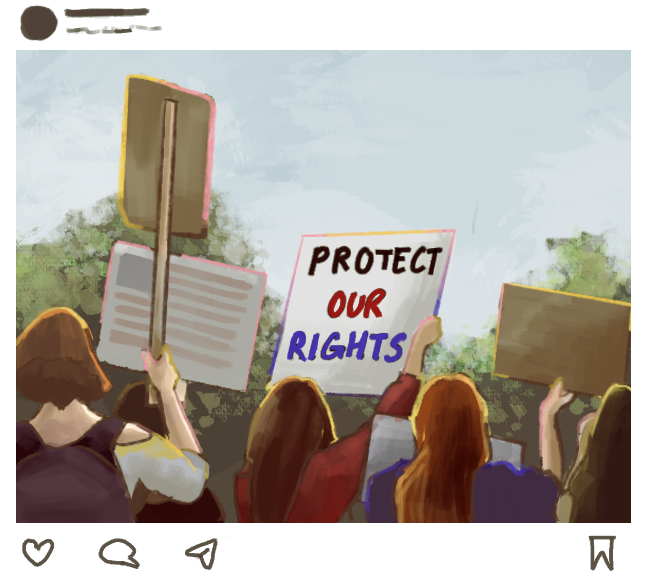
Junior Brian Miller walks down El Camino, taking a moment to appreciate the nearly 1000 Palo Alto students who walked out of school for the ICE protest on Jan. 30. As one of the main organizers of this event, this moment meant a lot for him, following much hard work.
In planning and promoting this event, Miller said he took advantage of social media platforms like Instagram to spread awareness about the walkout. Miller is not the only teen increasing his activism. Across the country, thousands of high school students have walked out to protest ICE, and social media activism has increased for many high school students.
“Using social media as a way to express my political views stemmed from my natural tendency to share my thoughts and opinions,” Miller said. “I do think it is a core fundamental principle of the United States, to share your opinions, thoughts, and ideas freely.”
Despite his inclination to share his ideas, Miller said he worries about how his thoughts could be misconstrued.
“The only times I’m ever nervous to share my opinion are when I know it is likely to be misinterpreted,” Miller said. “I am open to people disagreeing with me, I am open to logical discussions, I am open to being told when I am wrong, but often when words are misinterpreted, they can be used as a means to disqualify the validity of the message.”
English teacher Marc Tolentino, who teaches in the Social Justice Pathway, said fear is a major factor to consider for protesting students.
“To be able to use your voice, you have to have a level of confidence that sometimes students don’t have,” Tolentino said. “And then you’re operating with this within a school that has so many rules, and students are sometimes afraid to kind of like, go against authority and stuff like that.”
Despite these concerns, Miller said he believes in the importance of expressing his opinion.
“People will assume things about your character regardless of what you post, regardless of what you say,” Miller said. “At the end of the day it is imperative that you know what you believe in, and actively remind yourself what you value.”
Junior Sione Fusimalohi agrees and said it is important for students to be informed.
“The more that people know what’s going on in their community, the more people can be aware, learn more and change their ways,” Fusimalohi said. “Try and uplift others with what you share rather than bring others down.”
Tolentino said a large part of his job in teaching SJP is making sure students feel like they can share their ideas.
“I think students need a place to grow,” Tolentino said. “So expecting someone to just automatically go out there, it’s great if they can do that and go out and protest because they’re so passionate about it, but at the same time, I do understand that it takes a level of confidence.”
Palo Alto Middle College student Mathilde Huynh, who is the President for Youth and Government as well as the Bay Area head of recruitment for the nonprofit Let’s Talk Unite said it’s essential for students to voice their opinions even if they don’t think it’ll make a difference.
“Sharing your voice is so important in political issues, some people might think that just one more voice won’t add much but truly every voice matters,” Huynh said. “This also doesn’t have to be going to a big protest, it can be talking to your neighbors or friends at lunch.”
Similarly, Tolentino said students can find an arrangement of activities to support their causes or beliefs.
“There’s also a lot of subtle ways –– maybe diversify your friend group, because when you diversify your friend group, you develop empathy with people and you understand their stories,” Tolentino said. “And then another way can spark change too is, how do you spend your money? Are you participating in companies that contribute towards social oppression or not?”
Even if you’re not actively engaging in activism, Hyunh said it’s paramount for students to start building awareness.
“Teenagers aren’t as aware of the power that our voices have, and also democracy truly starts in your teen years,” Huynh said. “You also start building habits, while we may not be able to vote just yet, we are able to read the news and start getting opinions.”
Tolentino also said students can make an impact by supporting others, instead of having to start everything themselves.
“One of the most powerful people in leadership positions isn’t the leader, but it’s the first follower,” Tolentino said. “Because the leader is just the lone person doing their thing, but it’s the first person who’s brave enough to join that follower that really gives it momentum.”
Ultimately, Miller said teens who want to become more politically involved should not let their worries get in the way.
“If you are someone who cares, never let fear and judgement stop you from doing and saying what you believe in,” Miller said. “Living life as a good, genuine person, who cares about others will keep you on the right path, as long as you consistently remind yourself each day how to be better, and how to get after it.”
