
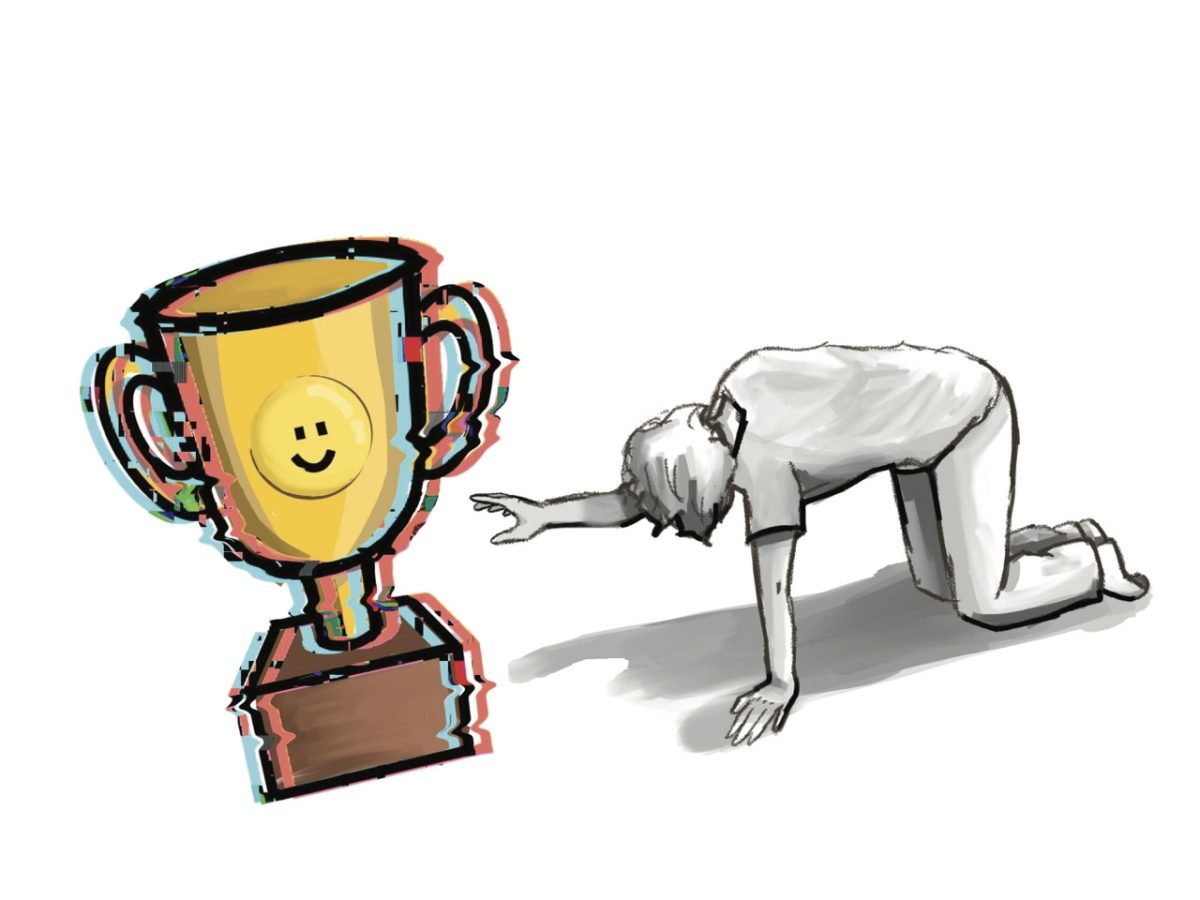
I’m lying on the floor of my bedroom, staring up at the ceiling and wondering: if I had everything, would I be happy? I’m hit by a sudden clarity: maybe I should stop trying to be happy.
You’ve probably heard the saying “Money doesn’t buy happiness” an exhausting amount of times. The adage is often used to point out the pitfalls of tunnel vision on material gains over deeper, personal connection.
You might’ve even seen the graph of money versus self-reported happiness, where happiness appears to increase and then plateau when the wants and needs of life are met, and the burdens of wealth — like transactional relationships and diminishing leisure time — begin to take their toll.
Ingrained in our society is the belief in the right to pursue happiness. From the Declaration of Independence and the American Dream to religion and modern overstimulation including social media and digital overload, humans have always been chasing a utopia of bliss, gratification and peace.
Money buys food, clothing, shelter, healthcare, opportunities, dreams, therapy and more. Money buys wants and needs, leading to personal gratification and freedom from worry. Money buys experiences — like travelling the world — that you would never have the ability to do otherwise. Money allows you to do what you love to do instead of what you have to do.
In that sense, money does buy happiness.
But stop and think for a moment — why are we buying this? What does happiness mean to you? What exactly are we chasing so desperately?
The average American today leads a better life than royalty a few hundred years ago. And yet, in 2023, 17.8% of Americans were experiencing or being treated for depression, up from 10.5% in 2015, according to a Gallup poll.
Clearly, material satisfaction is not all there is to life satisfaction.
But money can go beyond the physical. Money buys painkillers, literally but also figuratively.
One of the greatest challenges facing high schoolers is our inability to suffer. In a world of abundance and overstimulation, there are always things we can do to avoid, forget and sidestep being uncomfortable. Whether that’s doomscrolling, drinking and overeating or impulsive shopping, we tend to take the easy way out, to escape our problems and worries temporarily.
We can live on a constant stream of dopamine if we’re willing to pay the price — whether that be consequences to your health, relationships or dreams.
Imagine being in a constant state of artificially-induced, shallow and forced euphoria. You’re alive, but not living. You’re numb to suffering, but you can’t quite do anything meaningful either, because you’ve shut out the outside world and suppressed your ability to think.
You’re in a constant state of buried agitation and confusion, addicted to the idea of some elusive utopia (a word which literally means “no place”). You’re stuck — dependent on mind-numbing “painkillers” to feel OK.
With the ability to have and do almost anything through the convenience and instantaneousness of modern life, money does buy happiness, but happiness isn’t enough.
It’s time to rethink what happiness means, and what we should be focusing on instead.
As a society, we are becoming more open to conversations about mental health, facilitating connection and treatment. But, there lies one major issue: equating a lack of sadness with mental well-being, an often dangerous fallacy.
Happiness is an emotion, not a destination. Like all emotions, it is fleeting. The expectation that happiness was something I could forever hold on to was detrimental to my own mental health.
Pain is just as important as joy. Even if you still believe the pursuit of happiness is the meaning of life, pain teaches you what doesn’t work so you can make better decisions in the future.
Mental health is more than just the ability to address negative emotions — it is also the ability to endure them. Feeling sad, stressed or upset does not mean you need to be fixed.
When I stopped clinging on to the myth of happiness, I stopped fearing sadness. When I stopped idolizing happiness, I stopped demonizing pain.
Despite the dreaded workload and demands of junior year, I’m doing better than ever, and I credit that to my realization that happiness isn’t any more special or any more valuable than excitement, frustration or hopelessness.
It’s counterintuitive, but when I stopped caring about being happy, I was suddenly able to enjoy the simple act of being.
Money may buy happiness, but the belief that happiness is what we should be seeking is one of life’s greatest lies.
The “pursuit of happiness” is not a utopian destination but an endless chase that never leaves us satisfied. We turn in desperation to an array of modern painkillers that transport us to so-called perfect places, numbing our ability to think, feel and live.
But if the idea of happiness can be so integral to having purpose in life, what can replace it?
Maybe what we should chase is peace — being comfortable with being uncomfortable, knowing and being confident in who we are.
But you don’t have to do that, because you are not me. You don’t have to chase anything at all. Instead, you can live day by day, being present in the moment, knowing that happiness looks like gold but is not golden.
I’ll leave that up to you.
