
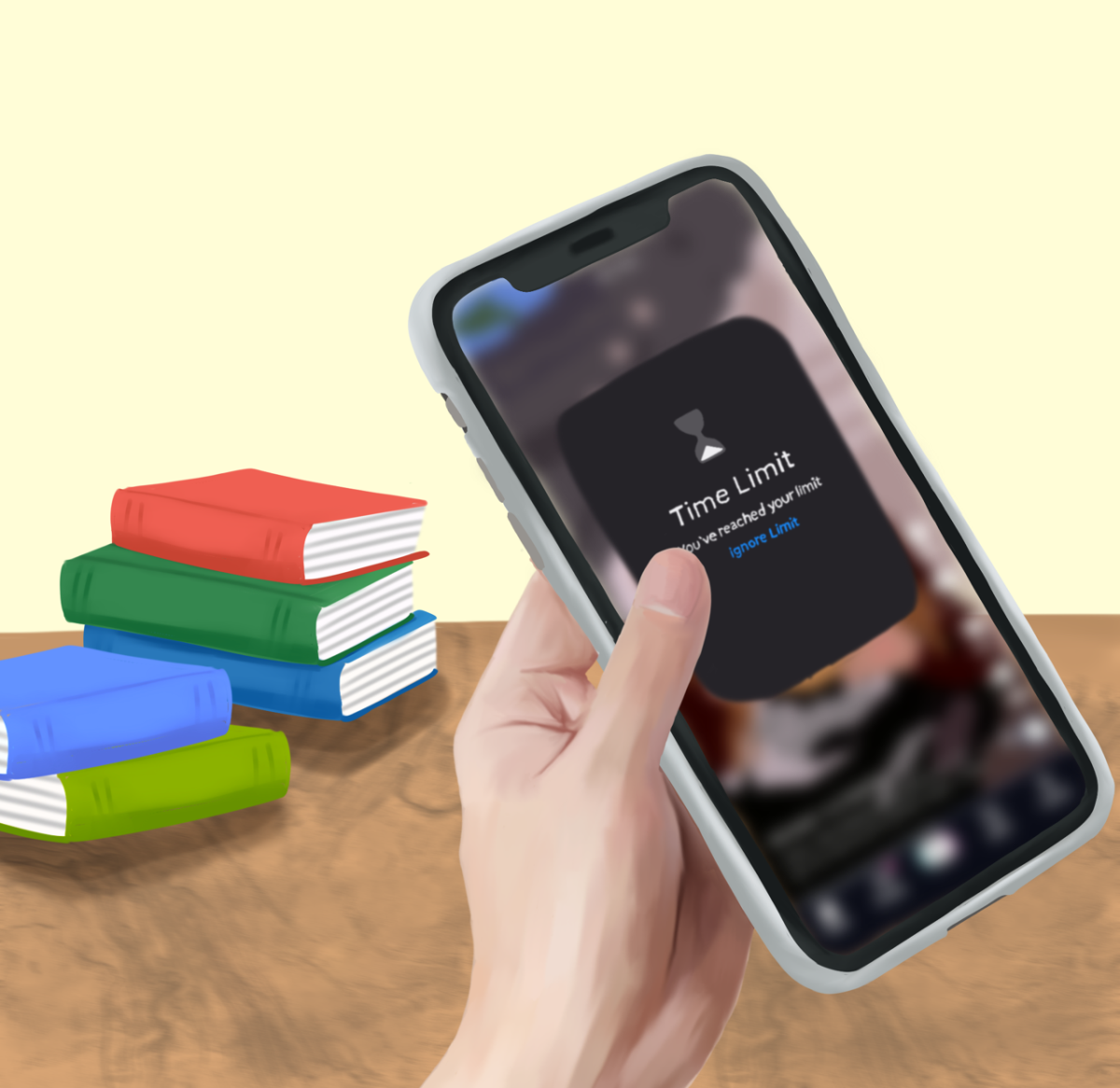
When junior Lise Concolato first walked through the halls of Paly her freshman year, she saw groups of students talking, laughing and enjoying time with friends. But as junior year progressed, Concolato saw more heads down than ever, eyes locked on their phones as students maneuvered through the halls.
Concolato said she has come to recognize how socially isolating and academically detrimental social media can be to teens as addictive platforms advance their engagement strategies. Since the widespread adoption of smartphones, young teens have become increasingly dependent on technology.
As a result, more adolescents are spending hours on social media platforms designed to keep users engaged. But in response, a growing number of teens and adults are recognizing the detriments of social media and turning toward self-imposed limitations on social media.
These solutions come in a variety of platforms — physical devices, online applications or a combination — each of which utilizes different techniques to achieve a digital detox. Popular apps include One Sec, Forest, Opal and Clearspace, while major physical devices include Brick, Blok, Bloom and phone lockboxes.
These tools limit factors such as the number of app opens, time per session and available features, while hardware devices often create barriers that involve physical actions like tapping a phone to a stationary device in order to lock or unlock it.
Some teens also use grayscale mode to make apps less visually stimulating, remove apps from their home screen to reduce the impulse to open them or switch to flip phones to restrict or limit access altogether.
Concolato said she has experimented with a variety of methods to restrict her own social media usage.
“First of all, I took Instagram off of my home screen so that it’s less (addictive) to click on it,” Concolato said. “And then, I also gave myself a five minute time limit, which, yes, most times I ignore, but sometimes I am able to stop myself and not go on Instagram. It’s just that extra minute of having to wait to unlock a thing that helps me get off of Instagram.”
Mark Wayland, a Bay Area parent and founder of On Paz, a startup building a physical social media limitation device, said a major shift of how platforms operate, from chronological feeds of solely followers’ most recent posts to algorithmic feeds of automated content, has contributed to the rise in teens limiting their use of social media.
“Between 2012 and 2014, all the big social media companies switched from chronological feeds to algorithmically driven feeds, and they did so to drive addiction and to try to keep us all on our devices for longer and longer,” Wayland said.
According to The Common Sense Consensus, 13- to 18-year-olds spend about 8.5 hours on social media per day, and this number is only growing as social media use increases each year – from 3% from 2015 to 2019 to 11% from 2019 to 2021.
Wayland said with a growing social media presence in people’s daily lives, social media addictions have similarly grown.
“Our brains develop until we’re 25, and what these apps are teaching people is (social media) is the way you can get a dopamine hit,” Wayland said. “So if you’re ever bored or restless or whatever it is, you can just always grab your phone, and you’re not bored anymore.”
Given young people’s increasing awareness and recognition of this addiction, teens and adults around the nation have started to find and create methods to limit their own social media use. Vicki Harrison, the Stanford Program Director at the Center for Youth Mental Health and Wellbeing, said teenagers are able to retake control of their lives by limiting social media.
“With this trend, I think teens are trying to reclaim some of the agency that they do not feel they have when it comes to use of today’s popular tech platforms,” Harrison said in an email. “I think taking steps that favor their health and wellbeing is a good thing and seeing and feeling that they have choices is important.”
Wayland said strategies involving physical separation from devices can be especially effective for digital detox.
“The average teen today spends eight to nine hours a day behind their screen for non-school or work purposes,” Wayland said. “I think that you should try to find time during the day where you do not have your phone. Your phone is not like your hands or like parts of your body that have to be with you all the time. You can be without your phone. You can leave it in another room. You can run an errand without it.”
Still, Wayland said one of the biggest obstacles to reducing screen time is social pressure.
“Every kid knows that they use their phone too much, but no one wants to be the only one not to use it,” Wayland said.
To prove that social pressure was indeed a challenge for teens, Wayland said he went to a sleepaway camp to ask kids their favorite thing about sleepaway camp. Wayland said they responded saying, “I loved being without my phone, but more importantly, I loved being without my phone when everyone else was without their phone.”
Similarly, Concolato said she has found limitations that restrict addictive social media scrolling while maintaining the communication messaging with followers are ideal.
“I really like these apps where it gets rid of the reel function, because I’m able to still use Instagram as a way to communicate,” Concolato said. “For me, I use Instagram to text my friends that are in different countries … so Instagram lets me know what they’re doing in their day to day when they’re posting and send each other funny reels so that we connect more without just simply texting.”
With many teens hesitant to limit their social media because of its restriction of communication with friends, adults have decided to start collective efforts including Wait Until 8th, a parent-led initiative encouraging families to delay giving children phones until at least the end of eighth grade. By having parents restrict phones use for every kid in the grade, it reduces any individual from feeling left out. Harrison said broader community involvement relating to social media restrictions is also significant.
“It is everyone’s responsibility, policymakers, tech industry, educators, parents, civil society organizations and youth themselves,” Harrison said. “I believe we need an all-hands-on-deck approach for tech use.”
Following a landmark case in the California Superior Court in Los Angeles County deciding Meta and YouTube were negligent in promoting addictive social media platforms to young users, many large companies are being forced to take responsibility for their actions. With evidence that their platforms harmed mental health, many further cases are expected to go to trial this year.
Although there is nationwide push for parents and the social media companies to help restrict social media use in teens, Harrison and Wayland both said social media has some positive features.
“There are many beneficial aspects to social media use and youth mental health, including identity exploration and affirmation, social support, humor and joy, connection with family and friends, education and skill building, mobilizing around a shared cause and community, creativity and the potential to earn a living,” Harrison said.
However, both still emphasize excessive social media use is linked to anxiety, depression and sleep disruption — which can affect relationships, academic performance and physical health. Concolato said because of this, she hopes to find effective strategies to use social media primarily for its benefits.
“I want to be able to go on my phone without feeling the need to immediately go to Instagram and scroll,” Concolato said. “I’m really hoping that either giving myself a time limit or using an app that controls what I can do on the apps will help me get out of that cycle … I just hope that we’re able to realize the effect that social media has on us, and the fact that while it can help us and be a positive thing in our lives, we also need to understand the consequences.”
Looking ahead, Harrison said meaningful change will require shifts in both user behavior and platform design.
Harrison said, “I hope for a future where tech products compete with one another on healthy and safe design features and young people can use their collective power to move their time, attention and data to platforms that work better for them and don’t require an ongoing struggle all the time.”
