
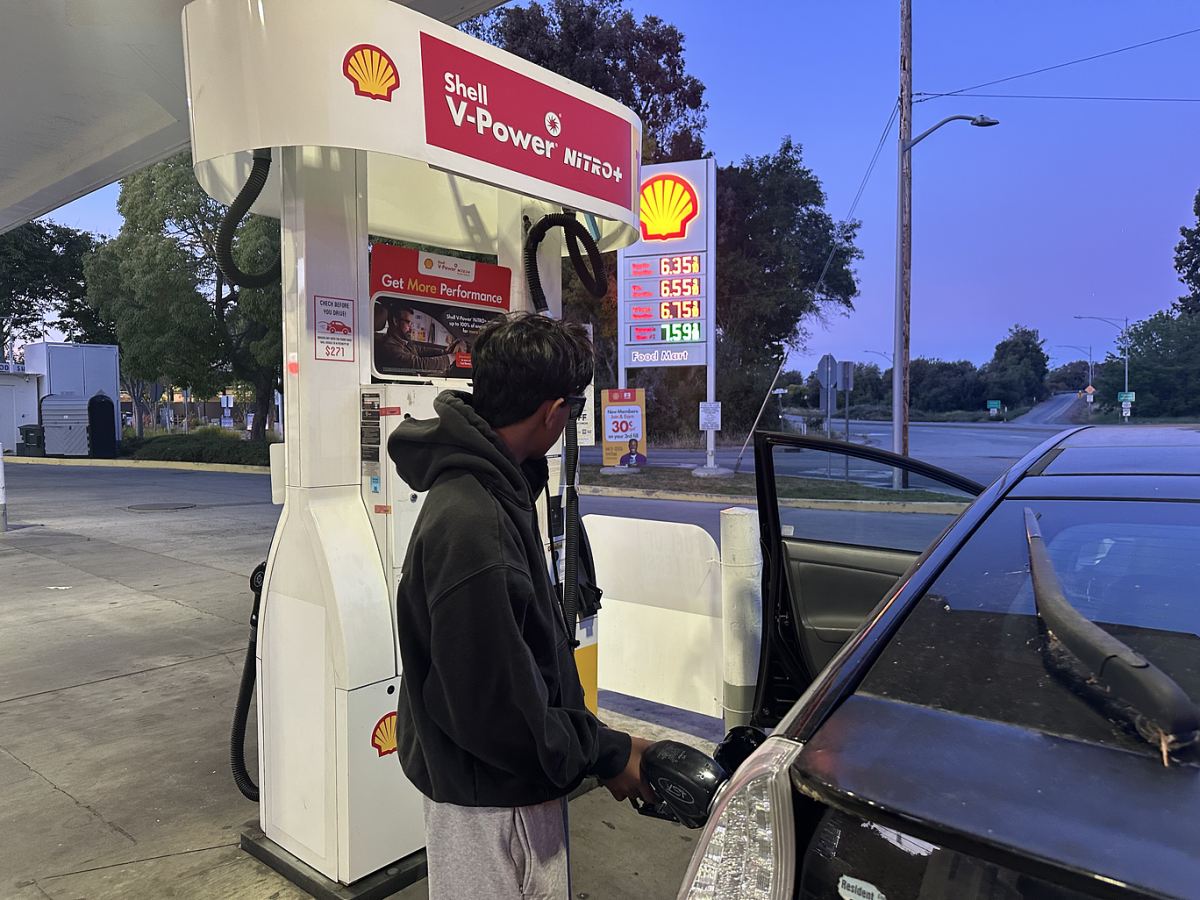
Since the start of the U.S.-Iran war, Americans have paid over $29.2 billion more than before the war for fuel. In California, gas prices have reached an average $6.01 per gallon, an increase of 30% when compared to pre-war prices. In an area already burdened with a high cost of living, many student drivers are being impacted by these rising gas prices.
Economics teacher Eric Bloom said in theory, gas prices should reflect the amount of demand from community members.
“Most people feel they need to drive, or they have to drive,” Bloom said. “So they get mad when prices go up, but it’s called an inelastic demand curve. They can’t really drive that much less. In theory, as the market price rises, consumption should start to drop, because people are less likely to be willing to pay that higher price.”
But Bloom said this theory is economically unrealistic because oil prices are determined by global consumers, and each country impacts the next.
“Oil is sold on a world market, so when the price of Iranian oil goes up, the price of Saudi Arabian oil goes up,” Bloom said. “Then, the price of American oil goes up because the global market says people are willing to pay a higher price. Now we could have Exxon and Chevron say they feel bad for people that the price of oil has gone up, so they’re going to take less profit and not raise their prices. Except for that never happens in capitalism. And so even though there’s been no constraint on the supply of American oil or Venezuelan oil or Mexican oil, the price of all oil has risen because the overall world market price is rising.”
Auto Shop teacher Doyle Knight said he has noticed student lifestyles have been affected by the rising gas prices.
“I know one kid; he was telling me that he’s actually riding his bike more now because he doesn’t want to put the money into gas,” Knight said.
Additionally, a rise in gas prices can impede student’s shift towards economic independence. Senior Esme Forshaw said she now finds driving a gas-powered car more difficult economically.
“How are teenagers expected to learn about money when everything is so expensive?” Forshaw said. “I drive a Mazda, which is fully gas, and the last time I got a tank it was $70 for the whole thing, which is crazy. I have to fill my gas up once every two weeks or so, so that’s around $140 a month on gas. And when I go to college, I don’t know how I’m going to pay for that.”
Bloom, though, said teens usually don’t bear the brunt of the cost of increasing gas prices.
“If they actually had to pay for their own gas, they might stop driving to school this much, or they’ll carpool and then cut costs in two,” Bloom said. “It’s easier for students if they don’t have to pay for their gas because they can drive the car that mom and dad drive. They’re not really responsive to price.”
Junior Luna Lim said rising gas prices have made her more appreciative of having access to an electric car.
“We use it as much as we can, and I’m really grateful for it,” Lim said. “I used to be kind of embarrassed of having a Tesla because of Elon Musk, but now I’m glad (we) don’t have to pay for gas.”
And Knight said he has also noticed a difference in the cars people choose to purchase and how they maintain them.
“Because of gas prices, people are actually choosing hybrid cars,” Knight said. “So that’s one big difference. The other is that … people would normally bring their cars in for maintenance, but because gas prices are so high, they don’t. They can’t afford it.”
Junior Seth Khan said especially in affluent communities like Palo Alto, higher gas prices disproportionately impact individuals of lower income.
“Palo Alto is already an expensive area, and the rising gas prices further drain people from their money in order to pay for gas,” Khan said “It’s emptying out anyone who can’t afford to be in Palo Alto and making it a very exclusively rich place. I think that’s ridiculous.”
According to the U.S. Department of Energy, the U.S. has around 400 million barrels of oil in its reserves, which are stored for major emergencies and disruptions to oil supply such as wars, economic crises and natural disasters. However, Bloom said the U.S. cannot fall back on this supply every time prices increase, as there is a limited amount of it.
“We’d only have about one or two months of oil if we took it out every single day,” Bloom said. “We fill it back up when oil prices are low. Oil prices have not really been that low since 2002, so it’s not filled back up yet. The idea of the strategic reserve is that if we can’t get resources, the government can choose to release oil instead of having people buy it on the market. So we could do that. The argument is that it would probably not make a huge difference, but could make maybe a five or 10 cents a gallon difference.”
Assuming gas price hikes stay constant, Knight said there are ways students and community members can maintain their cars to use less gas.
“(Check the) air pressure in your car and your tires,” Knight said. “People don’t think about air pressure, but they should check it once a month, because even though it’s supposed to be airtight, it still goes down. The other one is changing the oil. Just changing the oil does a lot for the engine, makes it run better.”
Looking forward, Forshaw said she fears rising gas prices and their affect on her financial independence in college.
“It’s really scary going into the future knowing that gas won’t just be a commodity that we can rely on,” Forshaw said. “Especially with the wars coming up, it’s really affecting prices.”
