
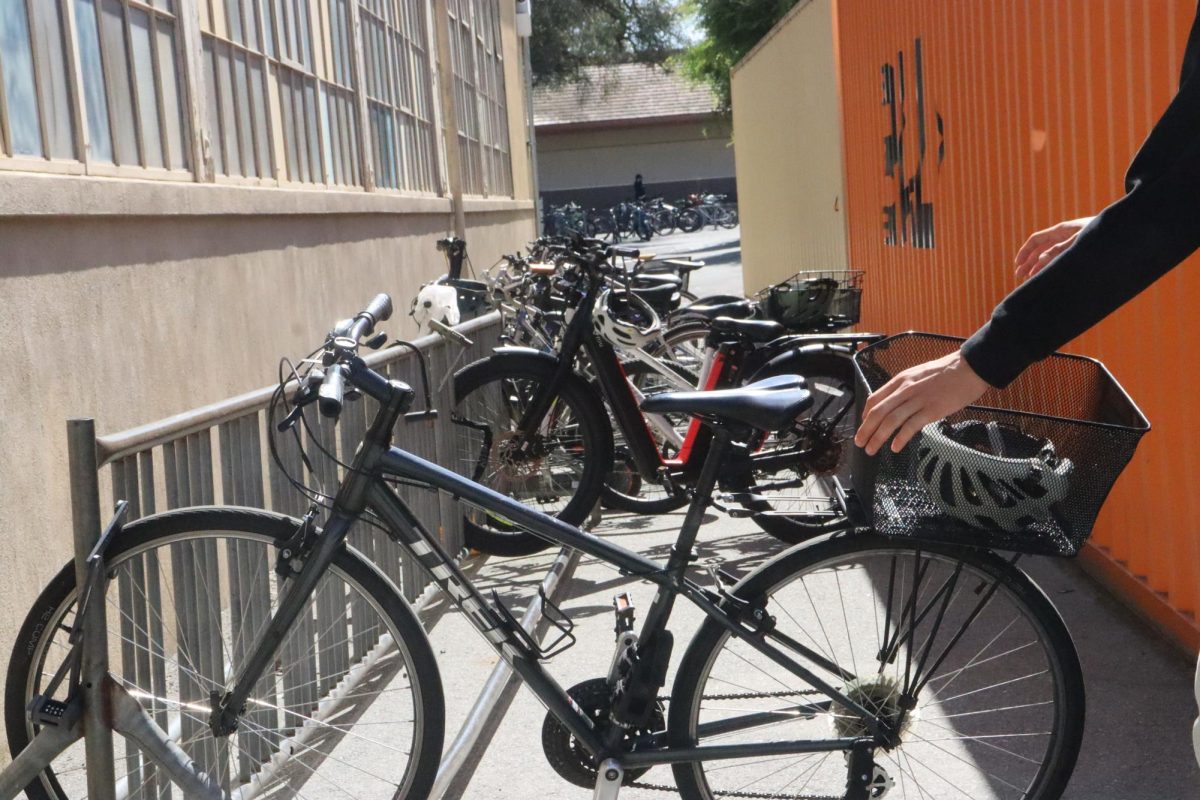
The Palo Alto Transportation Management Association has expanded Bike Love, a program launched in 2022 that rewards Palo Alto workers for biking in partnership with the smartphone app Motion. The program now offers payouts of $5 per ride up to $600 per year, set to encourage residents to shift away from driving and towards more sustainable methods of transportation.
Justine Burt, executive director of the Palo Alto Transportation Management Association, said the program aims to make eco-friendly commuting methods more attractive by offering app users an incentive to use these methods.
“Encouraging behavior change to more sustainable transportation options is about more than providing information,” Burt said. “Ultimately, it’s about whether perceived benefits of a new way of commuting are greater than the perceived barriers of making that change.”
Burt said the Bike Love app uses geofencing — a method that uses GPS technology to create virtual geographic boundaries — to automatically track when users enter designated areas, at which point they will receive an award.
“As soon as they pass that invisible barrier with their smartphone, $5 immediately goes onto a virtual debit card they can use at any brick-and-mortar store in Palo Alto,” Burt said.
Social studies teacher Austin Davis, who bikes to work, said he supports the idea of the program but thinks it will need adequate publicity to succeed.
“I already ride my bike to school, so if I can get extra money to do what I’m already doing, that sounds excellent,” Davis said “I feel like if it’s not well-publicized, it will just reward people who already bike.”
Burt said the program has already accounted for some of these criticisms, and also said many users have moved from driving to using refurbished bikes.
“Critics have said that Bike Love pays people for biking who probably already were biking to work,” Burt said. “Many people who start using Bike Love come to us asking for a refurbished bike so they can bike to work. Then we refer them to the Silicon Valley Bike Exchange to receive their refurbished bike.”
Even so, Davis said there are many reasons why someone might choose to drive instead of bike.
“Maybe you have to buy a bike in the first place, and then you have to deal with the fact that you can’t carry everything with you,” Davis said. “Not everyone can bike the distance (to work), and biking might take too much time out of their day.”
While Davis said the program is a good step forward he thinks it may be less impactful than expected.
“An incentive program seems like a place to start, but it’s not going to remedy the larger traffic problem or pollution problems,” Davis said. “On its own, the program is unlikely to yield a lot of change.”
Still, AP Computer Science teacher Christopher Bell said the habits the program is trying to instill in the community are important.
“I’d love to see more people taking public transit,” Bell said. “I’d love to see people biking to work, so the more that we get people to want to do that the better.”
And Burt said biking is not only important for the environment, but also for personal well-being.
“The point of the app is to encourage people to try biking to work and hopefully develop a habit,” Burt said. “They get exercise and fresh air and bike among the tree-lined streets of Palo Alto, all of which is great for mental health, too.”
Moving forward, Burt said the program is looking at alternative funding measures, such as feebate systems, to attract more users to the platform.
“A feebate is a charge levied on a behavior you want to discourage, like driving a gas-powered car, that uses the revenues to encourage the behavior you want, such as biking to work,” Burt said.
Ultimately, Burt said Bike Love’s goal is to help address the broader issue of sustainable transportation and employee well-being.
Burt said, “Success is having another tool in our tool chest to encourage sustainable mode shift that improves workers’ lives.”
